The Impact of GenAI on Human Creativity

Featured

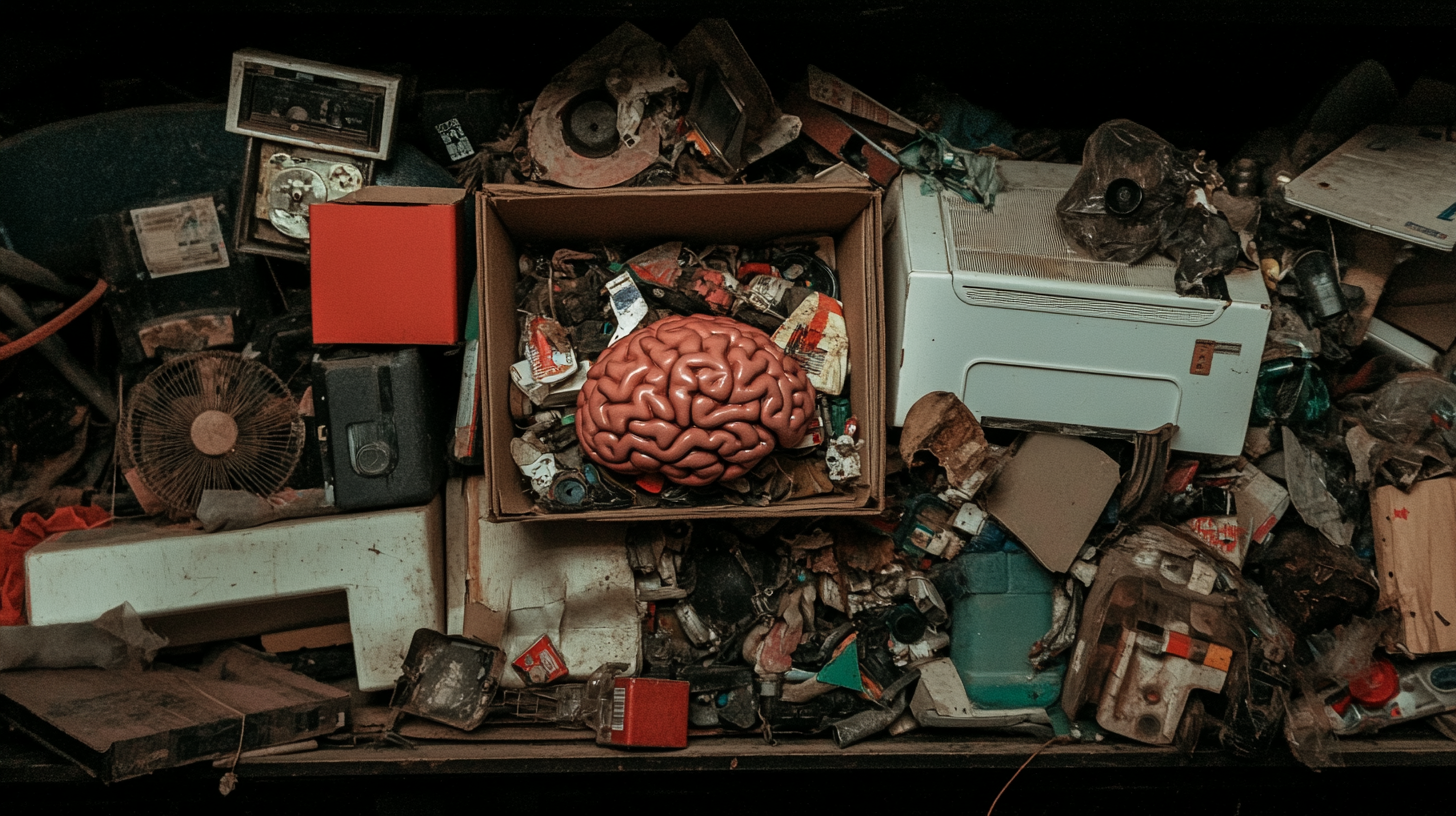
A brain in a box. By: Midjourney

Our work should never be just about our tools. It’s about the thinking behind them. Much of the GenAI debate has focused on whether and how well the tool “works” and what or who it can or can’t replace. But recently, I’ve been thinking more about its impact on how we think. And I suspect this question will only become more important as AI works better — or at least seems to.

Technology revolutions are always a double-edged sword. They bring leaps forward but come at a price. Our foundational myths make this clear: Prometheus gave humanity fire, but his punishment was eternal suffering. Pandora got all of the gods’ gifts and a box that unleashed chaos on the world. The forbidden fruit gave Adam and Eve knowledge — but at the cost of innocence and paradise lost. The lesson is old: power and progress always have trade-offs.

The tools that shape us

One of the core reasons for this dynamic is simple: we shape our tools, and in return, they shape us. Often in unexpected ways. Media theorist Marshall McLuhan famously explored this idea, though the oft-cited quote “We shape our tools, and thereafter our tools shape us” was actually a later paraphrase of his work. The idea, however, holds — every major technological shift alters not just how we work, but how we think.

This reminds me of a favourite quote (edited for brevity) from Neil Postman, who in Amusing Ourselves to Death (1985), argued:

“Tools hint at a form of thinking. Nature doesn’t speak, we talk about it, in any way we can. We see only our discourse about the world, this is our means of communication, the means are our metaphors and our metaphors create the content of our culture.”

When I first read Postman in my 20s, while deeply in love with the emerging web, I wondered what he’d say about the Internet, and found him fascinating but a bit of an alarmist. I was wrong. While he was warning about the impact of television (as form, not content), many of his fears proved accurate and apply to our world today: politics became entertainment, news became infotainment, and serious discourse struggled to survive in an attention economy.

Continue reading

Mind the drift: NotebookLM, WhatsApp chats, and the illusion of understanding

Generated by Midjourney 5

About a week ago, I experienced the most incredible AI demo since my first encounter with ChatGPT. Trust me, this is no exaggeration.

This post isn’t just about a cool tool; it also touches upon a crucial, unresolved issue in the world of Generative AI: handling those massive, complex data sets that are key to unlocking deeper value in many business and research areas.

Enter NotebookLM

I recently had a strategy brainstorming session with Angus Grundy (Angus is developing highly effective strategic frameworks; reach out to him if you’re looking to strategise/plan or think things through in any business or personal context. Insights guaranteed.). We recorded our 90-minute chat using Zoom’s AI assistant. Later, Angus used that transcript with Google’s experimental tool, NotebookLM.

On some levels, NotebookLM is a game-changer. You can upload extensive data sets (up to 50 files of 500,000 words each. That’s nearly 50 War and Peaces!) and interact with a chatbot in elaborate ways. You can ask highly specific questions and generate timelines, study guides, FAQs… all cross-referenced to your sources. You can then create notes from the chat results or add your own, shift focus between sources, manipulate it all, and more. You can even create, at the push of a button, an “audio overview,” where two AIs create a podcast-like discussion about the content. It’s as strange as it is delightful. But is it actually useful?

Continue reading

AI and creative development: Rocket fuel for human creativity?

Rocket fuel for human creativity? 🚀💡
Hear me out…

I have spent most of my career leading teams in the quest for breakthrough solutions (and searching for them myself). The typical process combines two approaches: quality-dominated development of “new stuff” and quantity-dominated curation of “existing stuff”.

1. Quantity dominated: curating numerous references to existing stuff in the hope of discovering inspiration or direction. Mood boards and best-practice research both work that way. This approach is cheaper, faster, and less demanding. However, this approach might not result in the desired breakthrough due to its dependence on previously explored concepts.

2. Quality dominated: developing fewer bespoke things that have not existed before. Think of a quality storyboard/draft/wireframe or even good scamps. It is slower and requires creation and iteration, mindfully mining opportunity spaces. It’s quite resource-intensive (time, money, energy, attention, people) to reach even a rudimentary prototype.  

Typically, you start in quantity mode and progress to quality, then alternate between the two. 🔄

Enter a third, hybrid mode of strategic creative development, which has an interesting “serendipity acceleration” effect. This the agile-adaptive approach that AI unlocks. It mixes our original ideas with a vast field of references (wider than any human can hold in their head). 
It can start at either end and can rapidly move to the other:

– Quality to quantity: You develop a significant bespoke seed and feed it to an LLM, trained on existing references, to rapidly generate new results for you to iterate. 💡➡️🌐
– Quantity to quality: you use prompts to generate a large number of starting points which, in the absence of bespoke seeds, gravitate more towards the existing references, but take a “quantity is quality” approach and select the best of those to develop and craft further. 🌐➡️💡

Note how the typical shift between divergence and convergence thinking, crucial to success, becomes faster and more cost-effective.

The third mode cultivates a dynamic and responsive creative process. It’s like rocket-fuel for serendipity, turbocharging the creative journey and maximizing the chances of finding that elusive ‘Eureka!’ moment. By leveraging human-machine collaboration, this approach accelerates not only serendipitous discoveries but also enables rapid generation, iteration, and refinement of ideas, making it easier for creatives to reach “terminal velocity” in their pursuit of breakthroughs, all while reducing the cost and time required.

It’s already happening, don’t get left out.

Version 1.5 of “The Sceptic’s Guide to ChatGPT” is out.

Language-Based AI: The Photoshop of Knowledge Work

Adobe stock. Seemed only fair.

All analogies are flawed, but some are useful.

Language-based AI is like Photoshop for the rest of us. 🖥️💃⚡

Hear me out… (less than 2-minute read)

In the world of graphic design, there was a time when only the most skilled designers could create high-quality visuals. It required many years of training and was a time-consuming manual craft.

But then, a tool emerged that changed everything — Photoshop. Suddenly, everyone with a computer could create stunning graphics, and the speed of production increased exponentially. This tool democratised the craft of design, making it accessible to the masses.

Adobe’s Creative Cloud approached 30 million paid subscribers last December. 🤯

However, despite this democratisation, not all designers were suddenly equal, nor will they ever be. Just as it is with many types of skills and tools — equal access doesn’t guarantee equal performance, let alone greatness.

But wait, there’s more to this analogy. 🤓

Photoshop was more than just a tool for making graphics. It also enabled designers to experiment with new techniques (that in the wrong hands scream “photoshop”), create unique styles, and push the boundaries of what was possible in design. And they still use real-world materials and inspiration.

Do designers have to keep up with the evolution of Photoshop? Most of them do. Or you can find your comfort zone and stay there. But unless you’re amazing, it comes at a price. Or you can decide you’re a 100% old-school craft artisan or let someone else import your work into Photoshop. There are implications for that too.

The arrival of AI in knowledge work is like Photoshop for the rest of us. AI is transforming the way knowledge workers operate, automating tasks we didn’t think could be automated, speeding things up exponentially, and providing new possibilities previously impossible.

But like with Photoshop, AI still requires human expertise to use effectively.

You are the designer, not AI.

Education, talent, and hard work still count. Hard work beats talent sometimes, but only up to a degree.

The power of AI lies in the hands of those willing to keep learning and adapting to the technology. But just because you have access to AI tools doesn’t make you a master of your field.

And downloading a pirated copy of Photoshop doesn’t make your nephew a top-tier graphic designer.

But maybe he could help you with that lost dog ad or retouch your dating photos.

Speaking of which, have you tried using it for job applications? It’s a game-changer. 😅

Finally, word processors that can actually process words.

But that’s another analogy…

Beyond the Hype: A Friendly and Sceptic User’s Guide to ChatGPT (v1.5)

Intro, or “Why like this!?” 

This guide is a labour of love for humans, not technology. It was born from my frustration with current writing about ChatGPT in general, and practical advice on LinkedIn in particular. And honestly — from a feeling of urgency, as I fear the bad advice will take hold and create bad business outputs, damaging careers and adoption rates for AI.  

Currently, the debate about ChatGPT’s usefulness (and the usefulness of language model chatbots in general) is dominated by the question “Is it a search killer?”. I believe this question comes from a spin that Big Tech propagates because it’s good for the share price. You can find my full view on that here.  But when this spin spreads into the practical discussion, framing our perceptions of how this tool may change our industry (by which I mean marketing, strategy, brand, media, creative, design, advertising, content, digital), the result is a blurry vision of what ChatGPT can do.  

This ‘blurry vision’ framing usually results in three kinds of ‘advice’:

  1. Don’t believe the hype
    “Look at the mistakes it makes, LOL; it’s not even as good as Google; there’s no serious use-case here. It’s a toy.” 
  2. This changes everything (superficially)
    “ChatGPT can do everything. Not only has research changed forever, and we no longer need to use search engines, but look at this brilliant [insert dull and superficial result] to [a crucial, nuanced and deep business/marketing/creative task].” 
  3. Moar content! Zero effort! 

“Here’s a listicle about how to use ChatGPT to create the most boring spammy articles and posts the world has ever seen.”

None of these are helpful,  or give meaningful guidance about how to use these new tools in our daily working life. Rather, they lead you down a garden path, at the end of which there’s a fork in the road and a signpost that reads, “this way to arid desert” or “this way to cloud-cuckoo-land”. 

Read the full guide here.