The history of the Apple brand is far more meandering and complex than many people care to admit. It’s so meandering that it’s quite challenging to tell it chronologically, so, let’s look at overlapping and shifting themes instead.
When people talk about Apple as a brand, they often envision a minimalistic premium lifestyle brand, but that’s a relatively recent incarnation.
Sadly, my brain absorbs marketing communications like a sponge and then loses sleep over incongruent thinking, so here are some “Apples” that may surprise you.
Prompt: the tower of babel made of neon marketing ephemera against a stormy sky (MJ5)
It’s often said that the very things that initially attract you to someone are the things that eventually begin to grate on your nerves. This old saying perfectly captures my relationship with the marketing industry.
Early days, I fell in love with Marketing’s creative, “whatever works” approach. A magpie-like mentality to pick and choose the best concepts and strategies for success from our own as well as other disciplines. Yet, over time, I have become increasingly frustrated with the neverending onslaught of synonymous, mutated, and spliced frameworks, models, labels, jargon, and “stuff”. It’s bloody exhausting.
The tragedy of this situation is that the genuine ideas, original concepts, research and science that underpin our profession are buried beneath this barely held-together tower of shiny marketing trinkets. This dearth of context and historical understanding has led me to call my blog “Marketing Babylon”. Way back in 2006, when I was still a fresh-faced agency-side rookie.
The paradox of marketing is that the creative freedom we love is both our saviour and our tormentor. It’s what makes our industry innovative and adaptable, but it also spawns a convoluted mess that leaves most marketers befuddled and, frankly, less effective. And in a classic “it’s always the children who suffer”, it also stunts the growth of our junior team members, even those with some formal training.
I have spent most of my career leading teams in the quest for breakthrough solutions (and searching for them myself). The typical process combines two approaches: quality-dominated development of “new stuff” and quantity-dominated curation of “existing stuff”.
1. Quantity dominated: curating numerous references to existing stuff in the hope of discovering inspiration or direction. Mood boards and best-practice research both work that way. This approach is cheaper, faster, and less demanding. However, this approach might not result in the desired breakthrough due to its dependence on previously explored concepts.
2. Quality dominated: developing fewer bespoke things that have not existed before. Think of a quality storyboard/draft/wireframe or even good scamps. It is slower and requires creation and iteration, mindfully mining opportunity spaces. It’s quite resource-intensive (time, money, energy, attention, people) to reach even a rudimentary prototype.
Typically, you start in quantity mode and progress to quality, then alternate between the two. 🔄
Enter a third, hybrid mode of strategic creative development, which has an interesting “serendipity acceleration” effect. This the agile-adaptive approach that AI unlocks. It mixes our original ideas with a vast field of references (wider than any human can hold in their head). It can start at either end and can rapidly move to the other:
– Quality to quantity: You develop a significant bespoke seed and feed it to an LLM, trained on existing references, to rapidly generate new results for you to iterate. 💡➡️🌐 – Quantity to quality: you use prompts to generate a large number of starting points which, in the absence of bespoke seeds, gravitate more towards the existing references, but take a “quantity is quality” approach and select the best of those to develop and craft further. 🌐➡️💡
Note how the typical shift between divergence and convergence thinking, crucial to success, becomes faster and more cost-effective.
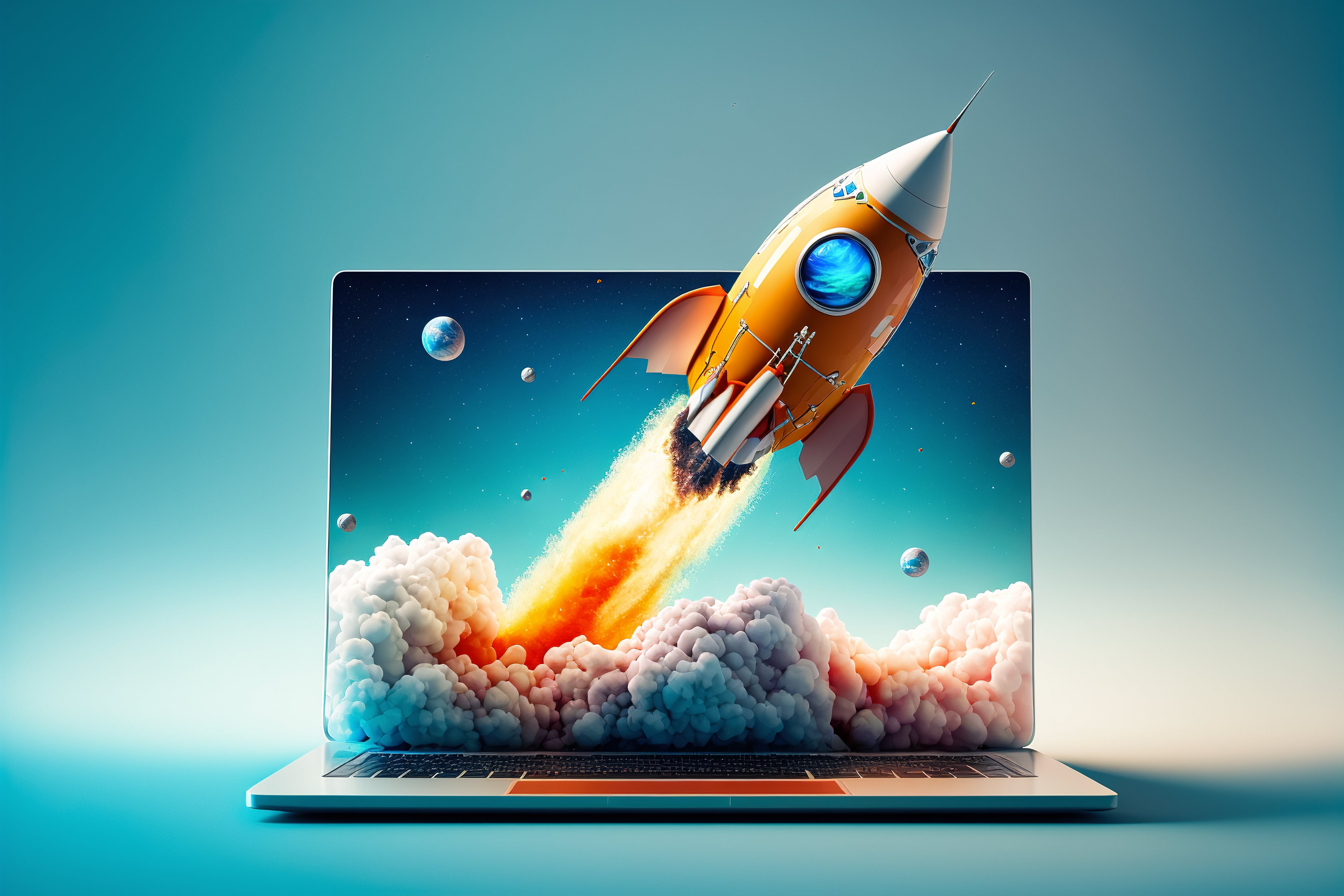
The third mode cultivates a dynamic and responsive creative process. It’s like rocket-fuel for serendipity, turbocharging the creative journey and maximizing the chances of finding that elusive ‘Eureka!’ moment. By leveraging human-machine collaboration, this approach accelerates not only serendipitous discoveries but also enables rapid generation, iteration, and refinement of ideas, making it easier for creatives to reach “terminal velocity” in their pursuit of breakthroughs, all while reducing the cost and time required.
Language-based AI is like Photoshop for the rest of us. 🖥️💃⚡
Hear me out… (less than 2-minute read)
In the world of graphic design, there was a time when only the most skilled designers could create high-quality visuals. It required many years of training and was a time-consuming manual craft.
But then, a tool emerged that changed everything — Photoshop. Suddenly, everyone with a computer could create stunning graphics, and the speed of production increased exponentially. This tool democratised the craft of design, making it accessible to the masses.
Adobe’s Creative Cloud approached 30 million paid subscribers last December. 🤯
However, despite this democratisation, not all designers were suddenly equal, nor will they ever be. Just as it is with many types of skills and tools — equal access doesn’t guarantee equal performance, let alone greatness.
But wait, there’s more to this analogy. 🤓
Photoshop was more than just a tool for making graphics. It also enabled designers to experiment with new techniques (that in the wrong hands scream “photoshop”), create unique styles, and push the boundaries of what was possible in design. And they still use real-world materials and inspiration.
Do designers have to keep up with the evolution of Photoshop? Most of them do. Or you can find your comfort zone and stay there. But unless you’re amazing, it comes at a price. Or you can decide you’re a 100% old-school craft artisan or let someone else import your work into Photoshop. There are implications for that too.
The arrival of AI in knowledge work is like Photoshop for the rest of us. AI is transforming the way knowledge workers operate, automating tasks we didn’t think could be automated, speeding things up exponentially, and providing new possibilities previously impossible.
But like with Photoshop, AI still requires human expertise to use effectively.
You are the designer, not AI.
Education, talent, and hard work still count. Hard work beats talent sometimes, but only up to a degree.
The power of AI lies in the hands of those willing to keep learning and adapting to the technology. But just because you have access to AI tools doesn’t make you a master of your field.
And downloading a pirated copy of Photoshop doesn’t make your nephew a top-tier graphic designer.
But maybe he could help you with that lost dog ad or retouch your dating photos.
Speaking of which, have you tried using it for job applications? It’s a game-changer. 😅


 Marketing Babylon