Unknown's avatar

About Uri Baruchin

Uri is an international strategist based in London, specialising in brand, creative strategy, proposition development, CX and content. He runs a boutique agency, teaches the D&AD's masterclass in strategy, and is the strategy mentor for SCA. He writes about marketing, culture and technology.

The paradox of the paradox of choice

Can we talk about the paradox of choice?
You know, just before we happily let behavioural economics take over marketing strategy completely?

It’s not that simple.

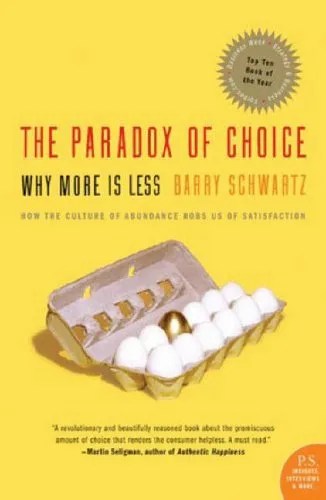
As behavioural economics become more important in marketing, Barry Schwartz’s 2004 best-seller and some writing that followed him are almost a dogma for some people:
Choice creates fatigue and anxiety → reduce choice to increase sales.

BUT, it’s just not that simple.
1. Choice overload isn’t a consistent effect
2. Choice reduction alone does not ensure an increase in sales

2015 meta-analysis of 99 studies isolated the circumstances in which reducing choices to customers is most likely to increase sales. What they identified are four factors:

  1. Choice set complexity
  2. Decision task difficulty
  3. Preference uncertainty
  4. Decision goal

And what they saw across studies is that when the above factors are mitigated, the tolerance for choice often increases.

Essentially, reducing complexity is more important than simply reducing choice.
Portfolio strategy is not an exercise in reducing SKUs.
Brand Architecture is not an exercise in killing and consolidating sub-brands.
And behavioural economics isn’t the silver bullet people think/pretend it is.
Because, unlike research, few marketing challenges concern a single, isolated, factor.
Sorry, I know you didn’t ask for a side of nuance with that.

How we think about disruption

0When it comes to market disruption the stories we tell now go further than the original definitions of disruptive innovation, coined by Harvard Professor Clayton M. Christensen in 1995, or disruptive technology, coined by economist Milan Zeleny, in 2009.

Today, the corporate conversation about disruption is influenced by its portrayal in the media, even in the trade media, and a specific “disruption trope” seems to dominate. Ideally, this is the story of a small but innovative brand coming “out of nowhere,” harnessing a technological breakthrough the brand came up with (or at least was the first to exploit), growing quickly, redefining the category, and making the “big guys” reassess their business model—to mention some components of the ideal story.

The real stories are rarely as “perfect.” For example, often disruptors aren’t the first to discover the breakthrough. Around the time Uber rose to prominence there were other GPS-based ride apps, and many also approached mini-cab stations in order to build a driver base more quickly. What made Uber into a disruptive player is that it combined a slick interface with smart data analytics, ruthless recruitment of drivers and, let’s face it, other forms of ruthlessness that attracted substantial negative coverage. Thus, they grew up the fastest.

The popularised disruption trope glosses over the details of a more complex reality. In fact, disruption comes in a variety of shapes and sizes. By appreciating a wider variety of tropes, we can learn to understand disruption better and the different roles brands can play.

Here are three examples of tropes: Continue reading

Strategy models are not orphans

13

Illustration by: @momok (I don’t have to credit, but I want to)

While developing work for both recent client projects as well as my D&AD masterclass, I realised one of the cardinal sins of the way many agencies and consultancies present strategy.

Most times, when an agency puts a model or a framework in front of a client, it as if it came from nowhere. It is almost never credited to the original inventors. Even agencies that would never share a creative work without crediting its origin (although orphan case studies and best practices are also common), often wouldn’t dignify strategy the same way. Continue reading

Bonfyres of vanities: the pitfalls of a cultural Fyre-Sale

1_sydfiDvPyMylHdSX0Xc-JQ

The great thing about the Fyre festival documentary (Netflix version) is that it works on so many levels. I think it’s a must-watch for anyone in the creative industry, media and the entrepreneur/VC space. Spheres of influence where realities are constructed and promoted, often with little regard to consequence. Let it be our cautionary tale.

Liar, liar pants on Fyre!

On a surface level, there’s the story of the epic disaster itself — a fractal-shaped clusterfuck of clusterfucks.

Early on, as a viewer, even if you had no awareness of the news story at the time, you think you know what’s coming because you know the premise. Well, guess again because it gets more and more extreme and peculiar –twist upon twist. It’s one of the things that make it such a weirdly enjoyable film to watch. I don’t want to drop any spoilers, but two moments that left me picking up my jaw off the floor were around the toxic ethos of ‘taking one for the team’ and the inevitable ‘force majeure’. More on those later. Continue reading

Has Gillette made a mistake? Marketing meets politics

So apparently some men out there are throwing their toys out of the pram because of Gillette’s ‘The Best Men Can Be’ advert.

Gillette dares to suggest the rising awareness of toxic masculinity, and its harm is an opportunity for growth. Perhaps (GASP!) for change, or even a commitment worth making. That’s just too much, man!

However, some men are raging, because, you know, #notallmen.

So let’s sort this thing out first, shall we? THEN we can discuss whether it’s sensible marketing… Continue reading