The Impact of GenAI on Human Creativity

Featured

A brain in a box. By: Midjourney

Our work should never be just about our tools. It’s about the thinking behind them. Much of the GenAI debate has focused on whether and how well the tool “works” and what or who it can or can’t replace. But recently, I’ve been thinking more about its impact on how we think. And I suspect this question will only become more important as AI works better — or at least seems to.

Technology revolutions are always a double-edged sword. They bring leaps forward but come at a price. Our foundational myths make this clear: Prometheus gave humanity fire, but his punishment was eternal suffering. Pandora got all of the gods’ gifts and a box that unleashed chaos on the world. The forbidden fruit gave Adam and Eve knowledge — but at the cost of innocence and paradise lost. The lesson is old: power and progress always have trade-offs.

The tools that shape us

One of the core reasons for this dynamic is simple: we shape our tools, and in return, they shape us. Often in unexpected ways. Media theorist Marshall McLuhan famously explored this idea, though the oft-cited quote “We shape our tools, and thereafter our tools shape us” was actually a later paraphrase of his work. The idea, however, holds — every major technological shift alters not just how we work, but how we think.

This reminds me of a favourite quote (edited for brevity) from Neil Postman, who in Amusing Ourselves to Death (1985), argued:

“Tools hint at a form of thinking. Nature doesn’t speak, we talk about it, in any way we can. We see only our discourse about the world, this is our means of communication, the means are our metaphors and our metaphors create the content of our culture.”

When I first read Postman in my 20s, while deeply in love with the emerging web, I wondered what he’d say about the Internet, and found him fascinating but a bit of an alarmist. I was wrong. While he was warning about the impact of television (as form, not content), many of his fears proved accurate and apply to our world today: politics became entertainment, news became infotainment, and serious discourse struggled to survive in an attention economy.

Continue reading

In time and space: Strategy

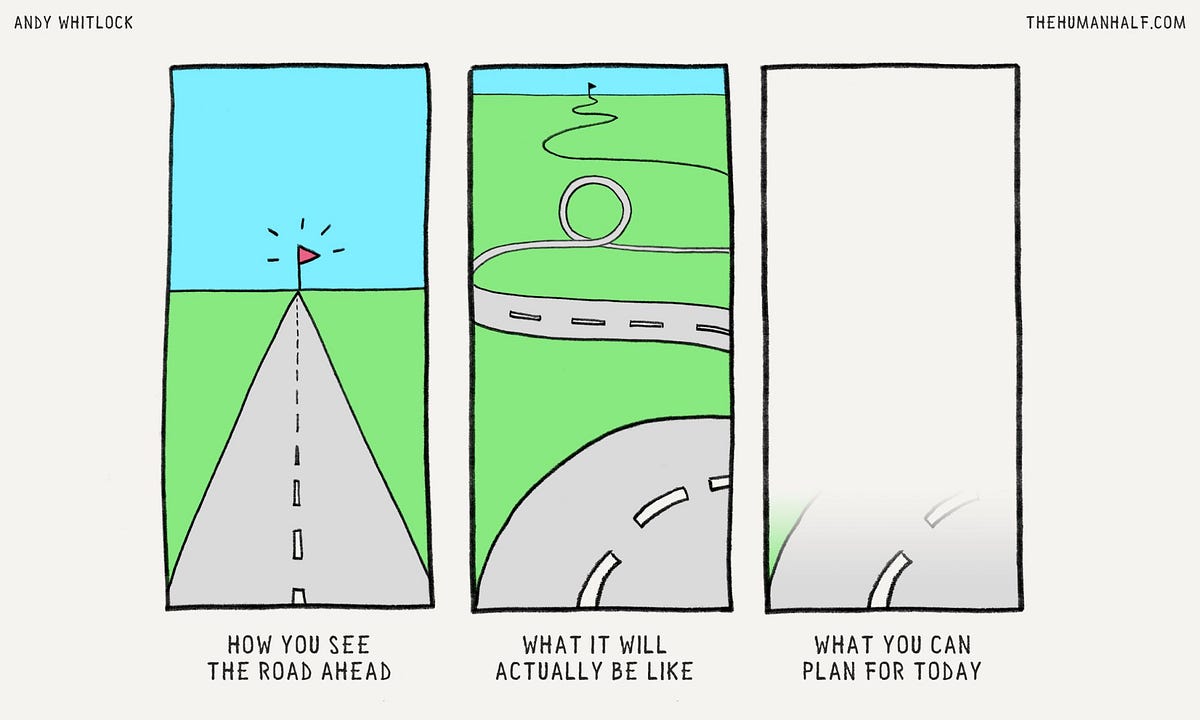
Roads by Andy Whitlock

Isn’t it fascinating that it’s nearly impossible to discuss “thinking,” which happens in time, without resorting to metaphors of space? No wonder Strategy finds its magic when it connects to the real world and leads to concrete results.

I was reminded of that when Andy Whitlock reposted this cartoon. (Comics masterfully navigate time and space in ways unlike any other medium — a topic for another space and another time.)

If I may, I’d like to build on Andy’s lucid points — with some thoughts on the strategic journey they portray.

Continue reading

Don’t settle for client-brief capture. Get-To-By should be more.

I recently had an enlightening conversation with the director team at one of my favourite creative agencies, and the Get-To-By (GTB) framework resurfaced yet again.

To clarify, there’s nothing inherently wrong with using the GTB framework to summarize a client’s brief concisely. Summaries are valuable, especially when they help capture the task at hand and perhaps contain a problem statement. You can also use them to show the client you understand their objectives.

However, issues arise when the process ends there, leaving creative teams with inadequate strategic guidance as they move into ideation and development. In short, neglecting to provide a solid creative strategy does them a disservice.

(It’s worth noting that GTB is not the only way to capture strategy. I personally prefer more straightforward, creative, and narrative-based frameworks.)

So, let’s revisit the advice from the original post:

The Get-To-By (GTB) framework, popularized by BBDO Worldwide and others, is widely employed in advertising. However, when misused, it can lead to weak strategies and misguided creative teams. An effective GTB should succinctly capture the audience, creative task, and strategy while avoiding non-strategies marked by empty loops and bare assertions.

To enhance GTB’s strategic efficacy, consider the following:

1. GET: Define a clear audience, connected to proper segmentation.
2. WHO: Meaningfully describe the audience, addressing their problems or perceptions.
3. TO: Identify the desired behavioural change that supports your end goal.
4. BY: Remember that ‘By’ is the heart of the creative strategy. Answer the ‘how’ and avoid closed loops or bare assertions.
5. Optionally, add a ‘Because’ to provide reasons to believe and ground the proposition.

By remaining mindful and strategic, we stir creative teams towards the most promising opportunity space(s), increasing the likelihood of positive outcomes.

Let’s devote more attention to crafting strategic GTBs and steer our industry clear of non-strategies.

#CreativeStrategy#Advertising#Marketing#GTBFramework#AgencyLife#StrategicThinking#CreativeBrief#BrandStrategy#GetToBy#BetterBriefs

Strategy models are not orphans

13

Illustration by: @momok (I don’t have to credit, but I want to)

While developing work for both recent client projects as well as my D&AD masterclass, I realised one of the cardinal sins of the way many agencies and consultancies present strategy.

Most times, when an agency puts a model or a framework in front of a client, it as if it came from nowhere. It is almost never credited to the original inventors. Even agencies that would never share a creative work without crediting its origin (although orphan case studies and best practices are also common), often wouldn’t dignify strategy the same way. Continue reading

The Apocalypse is bad for business

coming soon, by Digital Trash on Flickr

Coming Soon, by Digital Trash on Flickr

(The following post was originally published on Marketing Magazine’s Marketing Blogged blog. It has also been posted on Linguabrand’s Science and Learning section, among a highly flattering group. This is a delayed cross-posting.)

Expanding the definition and remit of sustainable marketing
When initially introduced to c-suites and boards, the allure of sustainability was that it made a certain brutal business common sense. Performance driven business leaders don’t have to love trees to understand that ignoring environmental impact will eventually kill their business: Materials and fuels will get more expensive, regulations will bear down on them and other forms of public scrutiny will become increasingly unforgiving.

Over the years, the remit of business sustainability has expanded from environmental responsibility to include other economic, social and almost any other aspect of responsible long-term resource management and social stewardship.

However, sustainable marketing has so far remained focused on the environmental aspect. It largely stands for paper sources, non-toxic inks, recycling, etc.

This is an oversight as it’s clear a large part of marketing’s impact on our society is not physical. I would like to challenge this narrow view of sustainable marketing by suggesting that just like businesses increasingly look beyond the environmental impact of resource management, marketing should do the same.

The two new elements I would like to introduce into the definition of sustainable marketing are the cognitive and the cultural aspects. Continue reading