Understanding Creative Strategy, part 3: The paradigm in the wild (advertising)

Get email notifications for this series and beyond by signing up here

The Paradigm

At the heart of our creative strategy model are the ‘marketing win conditions’ of Integrity, Relevance and Difference. I often refer to that part of the model as ‘The Paradigm’.

I use ‘paradigm’ because I believe it reflects one of the most prevalent and fundamental concepts in business and marketing. I admit that is an outlandish claim. Probably second only to attempting to create a unified model of creative strategy. But I stand by it.

A quick reminder: the paradigm defines how brands win in markets. Typically, they use aspects of their core competence to create a proposition for an audience that stands out from the alternatives (and against the general noise of the world). To do that, you need to get as close as you can to the audience (Relevance) and as far away from the rest (Difference). Often a balancing act. It’s deceptively simple.

(if you missed the visual summary, it’s here.)

Examples of the paradigm in advertising thinking

Here is a small collection of quotes and references that may sound different at first, but all reflect the same or quite similar three factors/aspects. This time we start with examples from Advertising and next time we’ll move beyond (it was too much for one post). Emphasises are mine.

Continue reading

Understanding Creative Strategy, part 2: model walkthrough and footnotes

Get email notifications for this series and beyond by signing up here

So, to recap — last time I had the cheek to suggest a unified model of creative strategy. This time, I’m going to get a little bit nerdy to unpack that model and the thinking behind it.

That model (name pending I guess, any ideas?) didn’t come out of thin air. I have complained in the past about our industry’s tendency to present models as orphans. So on some level part 2 is me being the change I want to see in the world…

I could have tagged all the people mentioned, many are on LinkedIn, but I’d like to think I’m not THAT kind of LinkedIn user. 🙂

Notes on the shoulders of giants:

Continue reading

Understanding Strategy, part 1: a simple unified model for creative strategy

Building a simple unified model for creative strategy — in three layers (and triangles)

Get email notifications for this series and beyond by signing up here

Marketing and advertising are suffering an effectiveness crisis. Experts and practitioners both agree that creativity plays an important part of the solution.

But to make it work, we need to bridge a rarely addressed gap.

People often think creative strategy is ‘fluffy’ or irrational. Especially compared to business strategy, marketing strategy or other X strategies. The worst examples certainly are. Still, the best practices of creative strategy are deeply rooted in marketing and align perfectly with classic business strategy. Here’s how I believe it works, looking back on my practise, while standing on the shoulders of giants*.

(* See notes in a separate post, where I also expand on some of my choices. Leaving the ‘scaffolding’ in made this post too long)

Layer 1: Fundamental market elements (Company, Customer, Context)

At a fundamental level, brands meet their audiences and stakeholders within a market context (typically including a competitive landscape). This concept is close to the well-known 3Cs model of strategic thinking popularised by management consultancies: Company, Customer and Competition. Small tweaks can be made to match sectors. For consumer brands, for example, the interaction is typically between Brand, Consumer, and Competition/Category (which sadly ruins the 3Cs memetic, unless we rename ‘Customer’ as ‘Audience(s)’ and get ABC). In our model, context replaces ‘Competition’ to expand into the wider category and broader cultural landscape.

Continue reading

Seeking resilience? Try being more strategic

(This is the written version of a talk developed during 2020 between IsolaTed TalksCIPR annual conference and the BMC podcast)

Last year, as I watched family, friends, clients, students, and myself adjust to the pandemic, I found myself thinking a lot about how people and organisations react to a crisis. The way they react shares a lot in common. Sometimes, our reactions shape us just as much as the crisis does.

Humans react to danger in instinctive and distinctive ways: fight, flight, freeze and fawn. Typically we show a predisposition to some over others. Evolutionary speaking, those mechanisms have positive roles too. To an extent, we can see them as ‘generic strategies’. To survive, our species needed this diversity. Taking the crisis heads on — fighters risk death. On the other hand, you can’t have a society of ‘flighters’ or they’ll run out of energy or options and die out too. Rigid templates weren’t enough even in prehistoric times. What remains is that when stress is high, people switch to ‘survival mode’ and default to their ‘type’, with the feelings that come with it — the fighters get angry, the flighters feel fear and anxiety, and so on. The go-to templates tend to become even more entrenched when a combination of high or persistent stress results in trauma. This type of rigid behavioural pattern is, in fact, an attribute of PTSD.

Organisations are like people in that sense. Once traumatised, even if the automatic response originally aided survival, it becomes ingrained. And then you get what I call ‘the post-traumatic organisation’.

Here are some symptoms I’m sure you’ll find familiar:

Continue reading

The paradox of the paradox of choice

Can we talk about the paradox of choice?
You know, just before we happily let behavioural economics take over marketing strategy completely?

It’s not that simple.

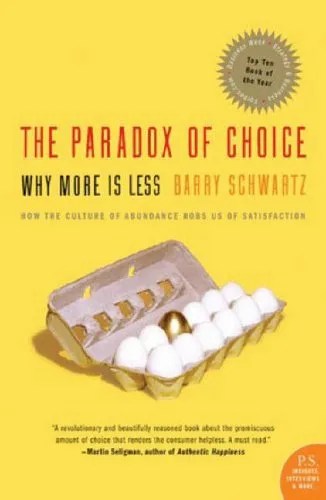
As behavioural economics become more important in marketing, Barry Schwartz’s 2004 best-seller and some writing that followed him are almost a dogma for some people:
Choice creates fatigue and anxiety → reduce choice to increase sales.

BUT, it’s just not that simple.
1. Choice overload isn’t a consistent effect
2. Choice reduction alone does not ensure an increase in sales

2015 meta-analysis of 99 studies isolated the circumstances in which reducing choices to customers is most likely to increase sales. What they identified are four factors:

  1. Choice set complexity
  2. Decision task difficulty
  3. Preference uncertainty
  4. Decision goal

And what they saw across studies is that when the above factors are mitigated, the tolerance for choice often increases.

Essentially, reducing complexity is more important than simply reducing choice.
Portfolio strategy is not an exercise in reducing SKUs.
Brand Architecture is not an exercise in killing and consolidating sub-brands.
And behavioural economics isn’t the silver bullet people think/pretend it is.
Because, unlike research, few marketing challenges concern a single, isolated, factor.
Sorry, I know you didn’t ask for a side of nuance with that.