
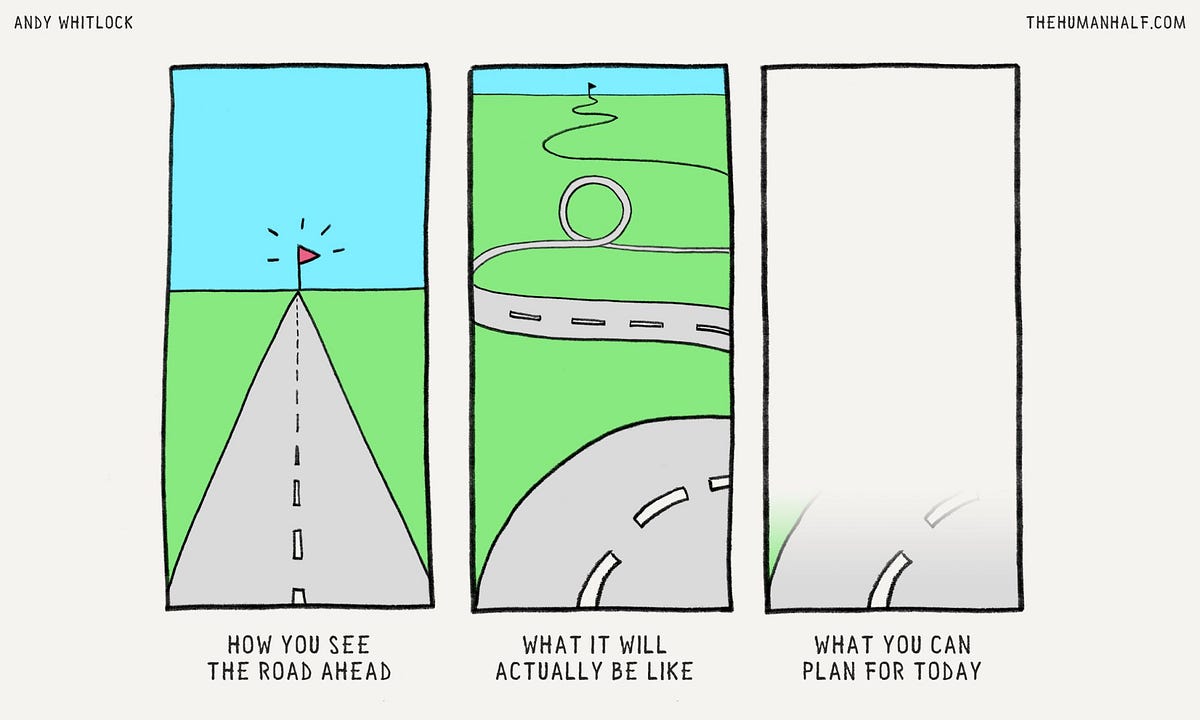
Isn’t it fascinating that it’s nearly impossible to discuss “thinking,” which happens in time, without resorting to metaphors of space? No wonder Strategy finds its magic when it connects to the real world and leads to concrete results.
I was reminded of that when Andy Whitlock reposted this cartoon. (Comics masterfully navigate time and space in ways unlike any other medium — a topic for another space and another time.)
If I may, I’d like to build on Andy’s lucid points — with some thoughts on the strategic journey they portray.
Panel 1: all eyes on the prize. If only.
A clear objective is a critical starting point. It’s what Roger Martin calls “The Winning Aspiration”, the motivation for strategy. Yet, in practice, stakeholders rarely align on objectives. They will argue the flag’s colour, location, or how to get there.
You’ll need to navigate that messy conversation before any strategy can be devised and find shared clarity amidst competing visions. It’s no wonder so many organisations get stuck at the end of that often exhausting stage — the most common type of non-strategy you’ll come across in business is probably confusing an objective for a strategy (this mistake is a central theme in Rumelt’s “Good Strategy / Bad Strategy”).
Panel 2: the long and winding road(s)
While Andy drew one winding path, the second panel reminds me of the “garden of forking paths” (Borges) — where each decision branches into another. Seemingly endless possibilities, each with its mix of feasibility, win-chance, and fit for the environment.
Some paths overlap or rejoin; others disappear entirely. Some routes become visible only when you start walking them; others require you to pave them as you go. If your path is too well-trodden, you’ll often find it leads to opportunity spaces that have been over-excavated and have little to no treasure left. In the current state of things, the terrain shifts constantly, and you have to run twice as fast just to stay in place (“Red Queen Syndrome”).
Research and market orientation — the cartography work for this landscape — can chart only so much. (Choose an exploration approach over plain research. Forward-looking, adaptive, and open to what could be, not just what is.)
Panel 3: the fog of uncertainty
Ah, the fog. Many businesses love ignoring this reality: you’re always operating with partial information. At any single point, peering ahead into a landscape shrouded in mist, many features are obscured or hidden. You can’t see where the paths lead, its obstacles, or its opportunities.
Astute strategic thinking shines a beam of light to cut through some of this fog — it can’t illuminate everything but reveals just enough to guide decisions. It may light up parts of a path, or maybe a single detail: a fallen tree, a bubbling brook, a bear. Clarity isn’t total, nor can it be. What matters is that, as the journey emerges, new findings may prepare you for what’s ahead.
 Marketing Babylon